REST API Explained Simply with Examples (Beginner Friendly Guide)
- System Design
- architecture
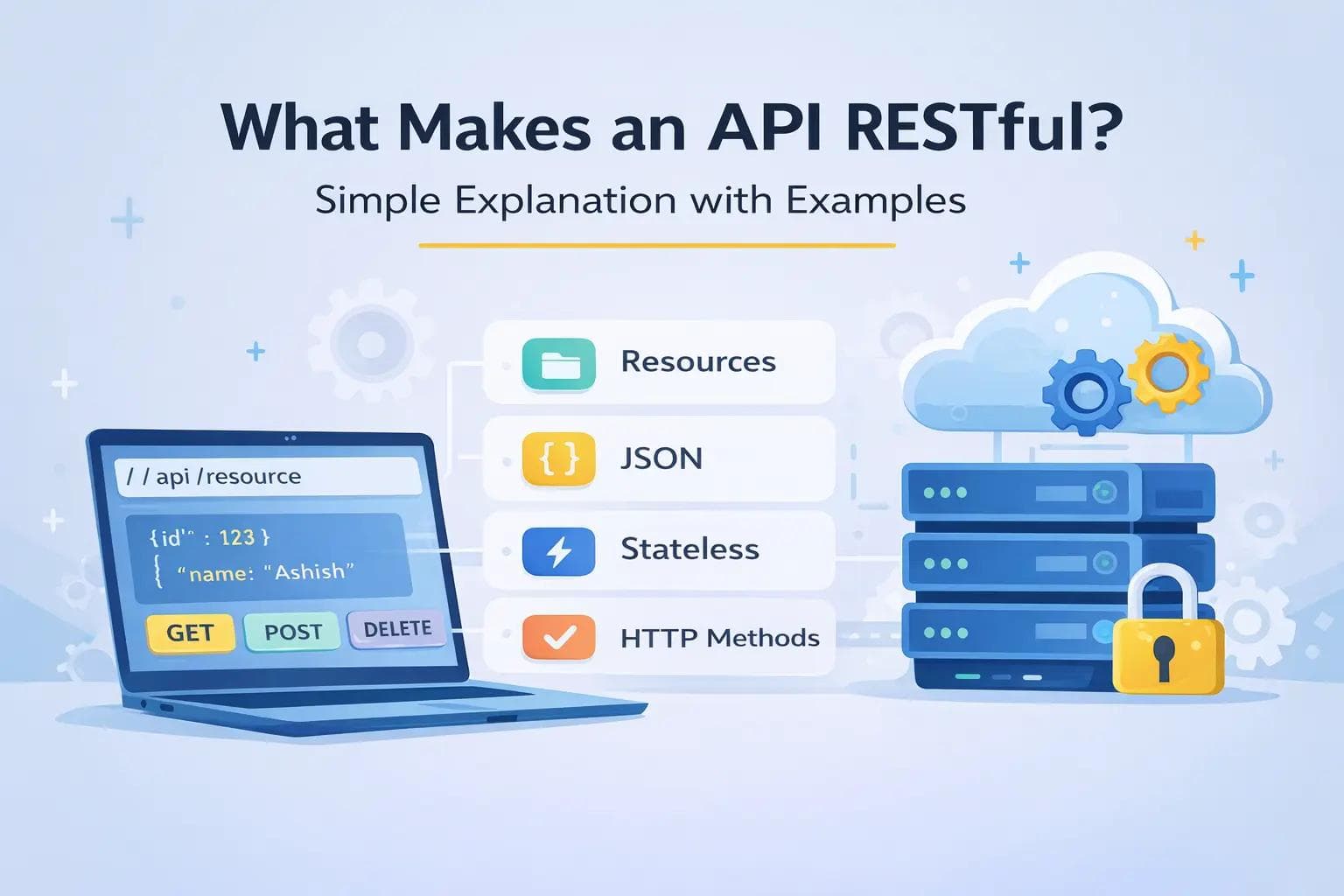
Modern applications communicate through APIs. Among all architectural styles, REST (Representational State Transfer) has become the most widely adopted approach for designing web services.
But what exactly makes an API “RESTful”?
This article breaks down REST into its core principles in a structured and practical way.
What Is a REST API?
A REST API is an API that follows REST architectural principles and uses HTTP to access and manipulate resources.
At its core, REST is about:
- Resource-based design
- Standard HTTP methods
- Stateless communication
- Language-independent data exchange
Understanding these principles makes API design predictable, scalable, and clean.
Core Principles of REST Architecture
1. Resource-Based Design
In REST, everything is treated as a resource.
Examples of resources:
- Users
- Orders
- Products
- Payments
Each resource is uniquely identified using a URL (Uniform Resource Locator).
Example:
/users/users/123
/users
/users/123
Important rule:
URLs represent nouns (resources), not actions.
Avoid below:
/getUser
/createUser
/deleteUser
Instead, structure it properly using resource names.
2. HTTP Methods Define Actions
REST uses standard HTTP methods to perform operations on resources.
| HTTP Method | Purpose |
|---|---|
| GET | Retrieve data |
| POST | Create a new resource |
| PUT | Update the entire resource |
| PATCH | Update partial resource |
| DELETE | Remove resource |
Example:
GET /users/123 → Retrieve user
POST /users → Create user
PUT /users/123 → Update user
DELETE /users/123 → Delete user
The URL remains consistent. The HTTP method determines the action.
This separation ensures clarity and uniformity across APIs.
3. Stateless Communication
REST APIs are stateless.
This means:
- The server does not store client session information.
- Each request must contain all the data required to process it.
If authentication is required, it must be included in every request (for example, via headers or tokens).
Why is statelessness important?
- Easier horizontal scaling
- Better load balancing
- Improved reliability
- Reduced server-side complexity
Since no client state is stored, any request can be handled by any server in the system.
4. Common Data Format (Typically JSON)
REST APIs usually exchange data in JSON (JavaScript Object Notation).
JSON is:
- Lightweight
- Human-readable
- Language-independent
- Widely supported
Example:
Request
GET /users/10Response
{
  "id": 10,
  "name": "EXAMPLE"
}
Because JSON works across all major programming languages, it enables seamless communication between frontend and backend systems.
Understanding API Parameters
REST APIs can include additional information through parameters.
1. Path Parameters
Used to identify specific resources.
/users/123Here, 123 is the path parameter representing a specific user.
2. Query Parameters
Used for filtering, sorting, or modifying results.
/users?age=25&city=LosAngelesCommon use cases:
- Filtering data
- Pagination
- Sorting
3. Cookies
Often used for authentication or session-related data.
Even though REST is stateless, authentication tokens may still be passed via cookies or headers.
Why REST Is Widely Adopted
REST has become the standard for web APIs because it is:
- Simple to understand
- Easy to implement
- Scalable
- Language-independent
- Compatible with existing web infrastructure
Its stateless nature makes it ideal for distributed systems and cloud-based architectures.
Related
APIs: The Secret Waiters of the Digital World
Confused about APIs? This beginner-friendly guide explains APIs, REST, requests, responses, and how apps communicate in simple words with examples.
HTTP vs HTTPS: A Complete Guide to Secure Web Communication
HTTP vs HTTPS explained: learn how SSL/TLS encryption works, why HTTPS matters for SEO, and how secure web communication protects your data.
Latency vs Throughput in System Design
Confused about latency vs throughput? This system design guide explains performance metrics with simple examples, diagrams, and real-world optimization tips.