Latency vs Throughput in System Design
- System Design
- architecture
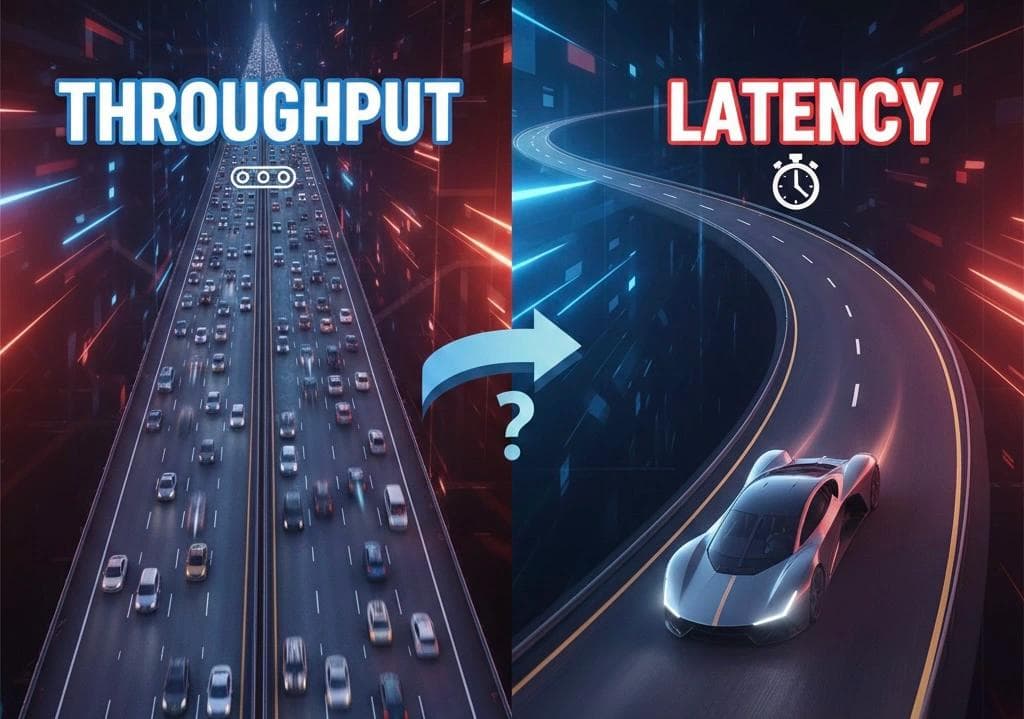
When people talk about system performance, two words come up again and again:
Latency and Throughput
These terms are used in software engineering, system design interviews, cloud systems, and backend development. But many beginners find them confusing.
In this blog, I’ll explain both concepts in simple terms, using real-life examples and practical system design thinking.
What Is Latency? (How Fast)
Latency is the time it takes for one request to get a response.
In simple terms:
Latency means: How long we need to wait ?
Real-Life Example
If you order food at a restaurant:
The time between ordering and getting your food = Latency
In software:
- Click a button
- Wait for the page to load
- That waiting time = Latency
What Makes Latency High?
Latency is made up of two main parts:
- Network Delay
- Time for data to travel on the internet
- Example: user in India, server in the US
- Processing (Computational) Delay
- Time the server takes to:
- Run code
- Query database
- Call other services
- Time the server takes to:
Latency = Network Delay + Processing Delay
What Is Throughput? (How Much)
Throughput is how many requests a system can handle in a given time.
In simple terms:
Throughput means: How much work can the system do?
Real-Life Example
At the same restaurant:
How many customers can be served per hour = Throughput
In software:
- Requests per second (RPS)
- Messages per minute
- Jobs per hour
All of these measure Throughput
How to Reduce Latency
Or How to make systems faster for users:
- Use Caching (Redis, in-memory cache)
- Use CDN
- Optimize database queries
- Reduce unnecessary service calls
- Use better hardware and infrastructure
How to Improve Throughput
To handle more users and more load:
- Use multiple threads
- Use async processing
- Add more servers (horizontal scaling)
- Use queues and background workers
- Reduce work per request
Important Real-World Truth
A system can be:
- Fast for one user (low latency)
- But still fail under heavy load (low throughput)
Or:
- Handle many users (high throughput)
- But each user waits longer (high latency)
Good system design is about choosing the right balance.
Why Every Developer Should Understand This
Latency and throughput are not just interview topics.
They affect:
- User experience
- System reliability
- Cloud costs
- Scalability
If you understand these two concepts, you already understand the foundation of system design.
Related
REST API Explained Simply with Examples (Beginner Friendly Guide)
Learn REST API basics with clear examples. Understand resources, HTTP methods, stateless architecture, and JSON in this beginner-friendly guide.
APIs: The Secret Waiters of the Digital World
Confused about APIs? This beginner-friendly guide explains APIs, REST, requests, responses, and how apps communicate in simple words with examples.
HTTP vs HTTPS: A Complete Guide to Secure Web Communication
HTTP vs HTTPS explained: learn how SSL/TLS encryption works, why HTTPS matters for SEO, and how secure web communication protects your data.