APIs: The Secret Waiters of the Digital World
- architecture
- System Design
APIs: The Secret Waiters of the Digital World
When we first hear API (Application Programming Interface), it sounds intimidating.
Big words.
Complex definitions.
Too much theory.
But honestly?
We already understand APIs in real life.
We just don’t call them APIs.
Let’s break this down together — like we’re learning side-by-side
What is an API, anyway?
API stands for Application Programming Interface.
Think of an API as a waiter in a restaurant.
Imagine:
- We = customers
- Kitchen = server
- Waiter = API
We:
- tell the waiter what we want (request)
- Wait a bit
- Food comes back (response)
We never go inside the kitchen.
We don’t cook the food ourselves.
We don’t need to know how anything works back there.
The waiter handles the communication. That waiter is exactly what an API does.
Key Takeaway: Similarly an API allows two different software systems to talk to each other without needing to know how the other one works.
How Information Travels: The "Digital Stack"
Think of it like sending a letter:
- The App → you write the message
- HTTP / gRPC → you put it in an envelope (protocol)
- TCP / UDP → choose delivery type
- TCP = guaranteed delivery
- UDP = faster but less certain
- IP & Network → address + local post office (Wi-Fi/Ethernet)
- Cable / Air → physical wires or radio waves that carry the signal
Finally, the server receives it and sends a response back.
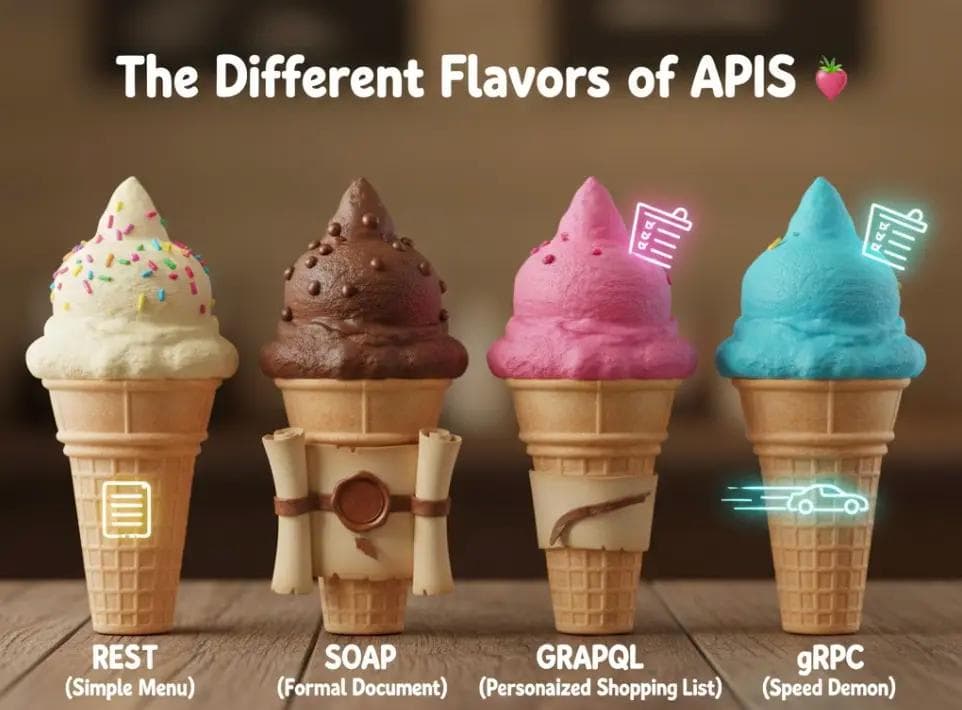
The Different "Flavors" of APIs 🍦
Not all APIs are built the same way. Depending on what a company needs, they might use a different "design."
1. Based on Design (The "Style")
- REST API: The most popular. It’s like a standard menu—simple, reliable, and uses web addresses (URLs) to get things done.
- SOAP: An older, more formal style. It’s like a 10-page legal contract; very secure but a bit heavy.
- GraphQL: The "Personal Chef." Instead of a fixed menu, you tell the kitchen exactly what ingredients you want, and they give you only that.
- gRPC: The "Speed Demon." Used mostly for internal systems to talk to each other at lightning speed.
2. Based on Access (Who’s Invited?)
- Public: Anyone can use it (like the Twitter/X API).
- Private: Only people inside a specific company can use it.
- Partner: Only specific, trusted partners (like a bank and a payment app) can use it.
Waiting vs. Not Waiting: Sync vs. Async
- Synchronous (Sync): This is a phone call. You ask a question and stay on the line until they answer. If the server is slow, you’re stuck waiting.
- Asynchronous (Async): This is like sending a text message. You send your request, go about your day, and the API "pings" you when the answer is ready. (Pro tip from the notes: AWS Lambda is a superstar at handling these async calls!)
Why Should You Care About APIs?
Without APIs, every app would be an island. You couldn't share a Spotify song to your Instagram story, you couldn't use Apple Pay, and you'd have to manually type in your credit card for every single purchase online.
APIs make the digital world connected, fast, and easy.
Related
REST API Explained Simply with Examples (Beginner Friendly Guide)
Learn REST API basics with clear examples. Understand resources, HTTP methods, stateless architecture, and JSON in this beginner-friendly guide.
HTTP vs HTTPS: A Complete Guide to Secure Web Communication
HTTP vs HTTPS explained: learn how SSL/TLS encryption works, why HTTPS matters for SEO, and how secure web communication protects your data.
Latency vs Throughput in System Design
Confused about latency vs throughput? This system design guide explains performance metrics with simple examples, diagrams, and real-world optimization tips.